
SHAPE DIFFERENCE


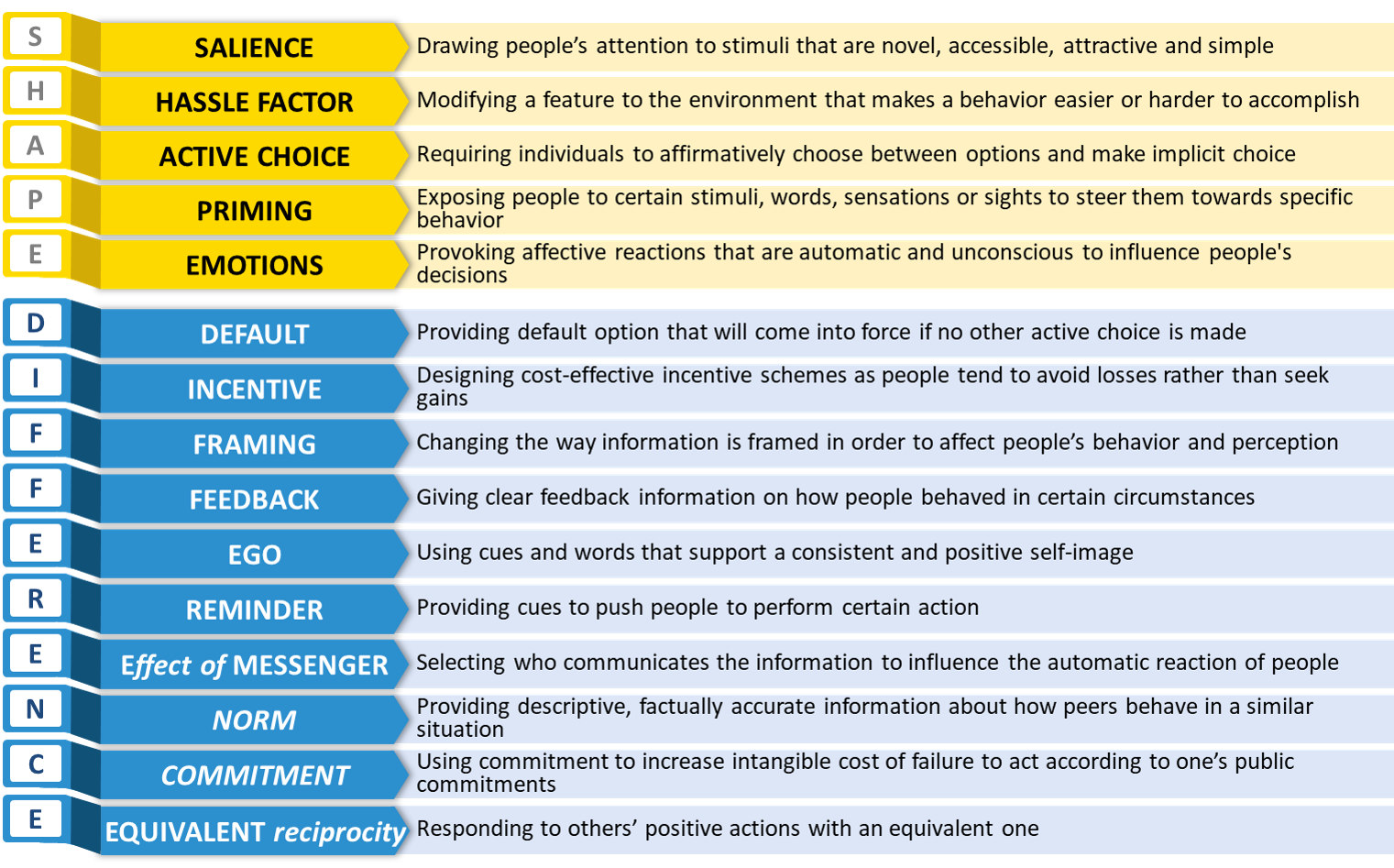
SHAPE DIFFERENCE is a joint Nudge Lebanon – B4Development proprietary framework that we use to develop nudges and behavioral interventions
 

Learn More

SALIENCE

Draw people’s attention to stimuli that are novel, accessible, attractive and simple, e.g.:

• Highlight the consequences of the behavior
• Make important dimensions noticeable
• Induce feelings and associations
• Use colors or imagery that stands out

How to apply?

Make the most important information or required action stand out so that it attracts attention.

Placing a large artwork on the steps of Melbourne’s Southern Cross station’s stairs increased their usage relative to escalators by 25%.

Learn more: BIT Report, Behavioural insights and healthier lives

HASSLE FACTOR

Modify features of the decision-making environment to make the desirable actions easier to accomplish, e.g.:
• Simplify the language, steps or information provided
• Eliminate unnecessary steps or requirements
• Minimize the time and effort required to complete an action

How to apply?

Remove unnecessary steps, simplify processes and provide checklists that are clear and easy to follow.

Providing new employees with a simple planning aid that illustrates the steps required to enroll in an employer-savings plan increased uptake by 42%.

Learn more: New Ways to Make People Save: A Social Marketing Approach, Lusardi et al. (2008)

ACTIVE CHOICE

Prompt individuals to make an explicit choice between available options.

How to apply?

Prompt individuals to make a decision by requiring them to actively choose between two or more options.

Asking customers if they would like to receive plastic cutlery with their delivery order reduced the demand for it by approximately 78%.

PRIMING

Expose individuals to stimuli, words, sensations or sights to trigger desirable actions.

How to apply?

Expose individuals to sights, words or sensations that encourage positive behaviors.

Adding a clean citrus smell (olfactory prime) and a picture of male eyes (visual prime) in a clinical setting improved hand hygiene compliance by 31.9% and 18.3% respectively.

EMOTIONS

Provoke automatic, unconscious affective reactions to influence people’s decisions.

How to apply?

Expose individuals to cues that provoke emotional reactions to encourage positive behaviors.

Sending a charity request letter with a picture and a brief description of the intended recipient increased donations by a factor of 1.5.

Learn more: Sympathy and callousness: The impact of deliberative thought on donations to identifiable and statistical victims

DEFAULT

Provide a preset course of action that takes effect if the decision maker does not make an explicit choice.

How to apply?

Automate the desired action to encourage more positive behavior.

Countries in which driving license applicants have to check a box to “opt-out” from becoming organ donors have significantly higher subscription rates to organ donation programs than countries that require drivers to “opt-in” to the program.

Learn more: Johnson, E. J. & Goldstein, D. 2003. Do defaults save lives? Science 302(5649), pp. 1338-1339.

INCENTIVE

Offer intrinsic (feeling good about ourselves) or extrinsic (monetary reward) incentives to motivate positive behavior.

How to apply?

Offer behaviorally-informed intrinsic or extrinsic incentives to promote positive behavior.

Offering teachers their bonus in advance and informing them that the bonus could be taken back if the students fail to perform satisfactorily increased student performance by a factor of 4 compared to teachers who received their bonuses at the end of the year.

Learn more: Enhancing the efficacy of teacher incentives through loss aversion: A field experiment, Fryer, Levitt, List, Sadoff (2012)

FRAMING

Change the way information is framed. Positive or negative frames of the same information could invoke different reactions.

How to apply?

Reframe communications to highlight the positive or negative consequences of an action (or the lack of it).
Test the effects of the different communication frames using surveys or focus group discussions. The context matters!

Sending school principals an email informing them that their school has been chosen to participate in a training program, and informing them that the school would risk losing its spot if they failed to sign up any of their teachers, increased the number of registrants by 33%.

FEEDBACK

Provide timely and relevant feedback information on how an individual is performing in relation to a preset goal or in comparison to others.

How to apply?

Create feedback loops that enable individuals to monitor their performance against a preset goal or in relation to others.

Designing energy bills that compare a household’s consumption with the consumption of their neighbors decreased the average daily power use by 2%.

EGO

Use cues and words that support a consistent and positive self-image.

How to apply?

Use positive prosocial traits that individuals can relate to.

Informing small businesses that their organization was chosen to receive information on government programs increased sign-ups by 52%.

Learn more: BIT, update report 2013-2015

REMINDER

Provide timely cues to help people overcome common behavioral barriers such as procrastination, imperfect memory and cognitive overload in order to complete tasks that otherwise would have been forgotten.

How to apply?

Consider the timing of the reminder, method of communication (SMS, WhatsApp, or in person) and the person delivering the reminder.

Reminding drivers to fasten their seatbelt through a verbal prompt delivered by the valet parking service at a 5-star hotel in Beirut increased seatbelt compliance by almost 83%.

EFFECT OF MESSENGER

Use a messenger who can influence or motivate people to act. The weight of the messenger depends on:
• Perceived authority
• Similarities between the messenger and the recipient
• Feelings towards the messenger

How to apply?

Think carefully about who communicates the information. This can be a person of authority, an influencer, a peer, a family member, etc.

Sending personalized letters to general practitioners in Australia from the Chief Medical Officer reduced the inappropriate prescription of antibiotics by 12%.

Learn more: Nudge vs Superbugs: Using behavioural economics to reduce the overprescribing of antibiotics.

NORM

Inform individuals what others around them or similar to them are doing to guide their own behavior, especially if the situation is novel or ambiguous.

How to apply?

Provide descriptive, factually accurate information about how the majority of people would behave in a similar situation.

Sending letters to citizens with tax debt informing them that 9 out 10 people in their town pay their taxes on time increased tax compliance by 23%.

Learn more: BIT Report: Applying Behavioural Insights to Reduce Fraud, Error and Debt

COMMITMENT

Use commitments with monetary or reputational costs if the action or preset goal is not achieved.

How to apply?

Encourage individuals to publicly commit to an action or achieving a preset goal. To classify as a commitment, the decision has to be voluntary and there must be a cost incurred if the commitment is broken.

Asking physicians to publicly display poster-sized letters in their clinics pledging to decrease the over-prescription of antibiotics reduced prescription rates by 19%.

Learn more: Meeker D, Knight TK, Friedberg MW, et al.Nudging Guideline-Concordant Antibiotic Prescribing: A Randomized Clinical Trial. JAMA Intern Med. 2014;174(3):425–431.

EQUIVALENT RECIPROCITY

Offer individuals a gift or a favor to encourage them to respond in kind.

How to apply?

Offer individuals assistance or help to encourage them to give something back.

Offering investment bank employees packets of candy as they entered their office building increased donation rates equivalent to one day’s salary by a factor of 1.2.

Learn more: Applying behavioural insights to charitable giving. BIT.