
• About Us
    • Who We Are
    • Our Approach: IDIAS
    • Our Framework
    • Board of Trustees
    • Our Partners
    • A Note from the Founder
    • In the News
  • Experiments
  • Our Publications
  • Our Initiatives
    • Consumer-Citizen Lab
    • “Proudly Non-Smoking” Campaign
    • CC Relief Platform
    • Transparent Hearts
  • BX Arabia
    • BX Arabia 2021
    • BX Arabia 2020
    • BX Arabia 2019
    • BX Arabia 2018
  • Contact us
    • Join our Team
Nudge
  • About Us
    • Who We Are
    • Our Approach: IDIAS
    • Our Framework
    • Board of Trustees
    • Our Partners
    • A Note from the Founder
    • In the News
  • Experiments
  • Our Publications
  • Our Initiatives
    • Consumer-Citizen Lab
    • “Proudly Non-Smoking” Campaign
    • CC Relief Platform
    • Transparent Hearts
  • BX Arabia
    • BX Arabia 2021
    • BX Arabia 2020
    • BX Arabia 2019
    • BX Arabia 2018
  • Contact us
    • Join our Team

Compare households’ recycling habits to their neighbors

  • Home
  • Ideas
  • Compare households’ recycling habits to their neighbors

Compare households’ recycling habits to their neighbors

  • Posted by Neu Notion Admin
  • Date January 23, 2020
  • Comments 0 comment

Give households feedback on their recycling pattern and use social norms to compare their pattern to their neighborhood’s.

Behavioral Tool: Feedback, Social Norms

Benchmarked Intervention

Experiment Overview

An experiment was conducted in California across 650 households to increase recycling using feedback, social norms and personalisation. The experiment had 3 treatment arms: (i) residents were given feedback about their recycling habits; (ii) residents were given feedback and dynamic social norms information such as the percentage of households recycling and their participation behavior; (iii) residents were given information about the type of materials that can be recycled. The control group that did not receive any intervention.

Impact
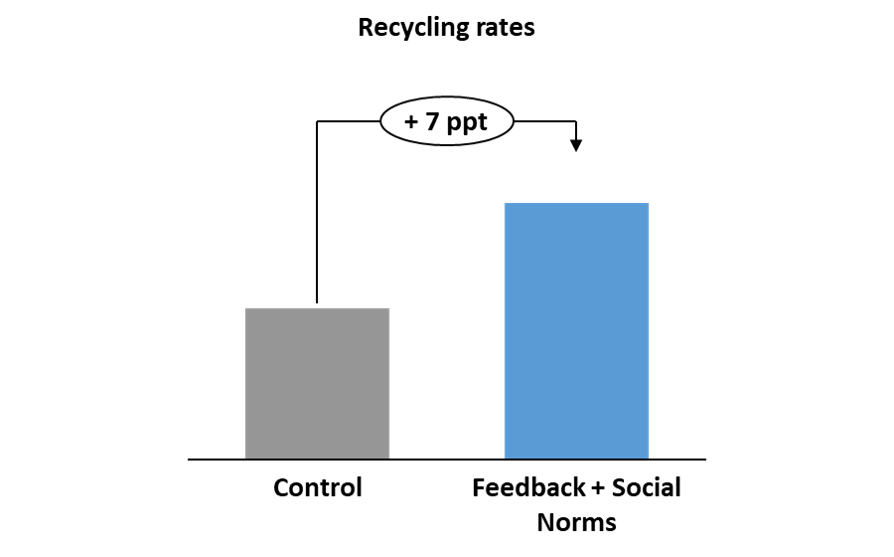
Source: Schultz, P. W. (1999). Changing behavior with normative feedback interventions: A field experiment on curbside recycling. Basic and applied social psychology, 21(1), 25-36.


  • Share:
author avatar
Neu Notion Admin

Previous post

Use commitment to increase uptake of recycling services
January 23, 2020

Next post

Provide incentives to encourage students to continue their education
January 23, 2020

You may also like

veg
Increasing Vegetarian Food Consumption at the AUB Cafeteria
31 January, 2020
shutterstock_456046198
Increasing Brown Bread Consumption in a University Cafeteria
31 January, 2020
Using a Self-Report Card to Improve Mental Health: Evidence from a clustered Randomized Controlled Trial
31 January, 2020

Executive Summary Mental health disorders have become one of the most common and serious chronic diseases in Lebanon where depression followed by anxiety constitute the two biggest mental health burdens. …

Leave A Reply Cancel reply

Your email address will not be published. Required fields are marked *

Search

Vision 1974 Building, 5th floor

Souraty Street

Beirut – Lebanon

Telephone: +961 1 744 988

info@nudgelebanon.org

Links

  • Contact us
  • Consumer-Citizen Lab

FIND US

Copyright © 2025 Nudge Lebanon

What can you donate? - عندك؟ تبرع

If you have any services or supplies that you can offer please do not hesitate to donate, all donations are highly appreciated.